
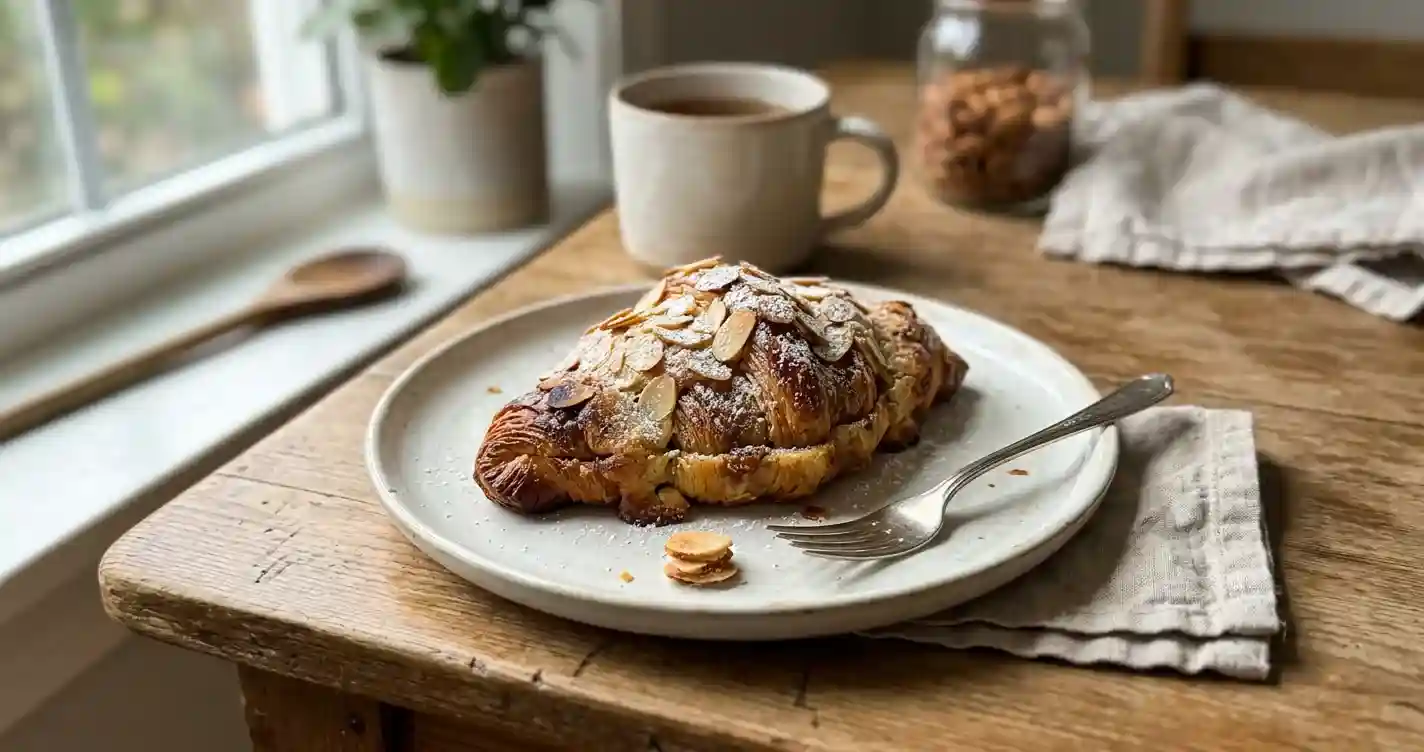
Almond Croissant Perfect in 6 Easy Steps at Home
Picture biting into a flaky, buttery pastry filled with rich almond cream and topped with crunchy sliced almonds and powdered sugar. That’s the magic of an Almond Croissant, and contrary to popular belief, you don’t need a French pastry degree to make this bakery favorite at home.
The secret? You start with store-bought croissants and transform them into something extraordinary through a simple filling and finishing technique. This approach delivers authentic Almond Croissant results in a fraction of the time it takes to make croissants from scratch. Moreover, the method is so forgiving that even beginners achieve impressive results on their first attempt.
In this comprehensive guide, I’ll walk you through every detail of creating bakery-quality Almond Croissant in your own kitchen, from selecting the right base croissants to achieving that perfect golden-brown finish with crispy almond topping.
Table of Contents
What is Almond Croissant
An Almond Croissant is a French pastry made by splitting a croissant horizontally, filling it with almond cream (frangipane), then topping it with more almond cream, sliced almonds, and powdered sugar before baking. The traditional French name is “croissant aux amandes,” and it represents one of the most popular variations in French bakeries.
The pastry originated as a clever way for French bakers to use day-old croissants. Rather than discarding yesterday’s unsold croissants, resourceful pâtissiers discovered that brushing them with simple syrup, filling them with almond cream, and rebaking them created an entirely new product that customers loved even more than fresh plain croissants.
The almond cream filling, called frangipane in French pastry terminology, consists of butter, sugar, eggs, and ground almonds. This mixture creates a rich, moist filling that contrasts beautifully with the flaky, crispy croissant layers. When baked, the frangipane sets into a tender, cake-like texture with intense almond flavor.
The simple syrup that soaks into the croissant serves multiple purposes. It adds sweetness, keeps the pastry moist despite the second baking, and helps the almond cream adhere to the croissant. Without this syrup, the croissant would dry out and the filling wouldn’t integrate properly.
Modern Almond Croissant variations maintain these essential components while occasionally adding touches like chocolate chips, amaretto liqueur, or orange zest. However, the classic version remains the most beloved for its pure, focused almond flavor.
Why You Will Love This Almond Croissant
First and foremost, making Almond Croissant at home costs a fraction of what you’d pay at a bakery. A single almond croissant at a quality bakery often costs five to eight dollars, while making a batch at home brings the per-pastry cost down to about two dollars.
The ability to control quality and freshness makes home preparation even more appealing. You choose exactly which croissants to start with, how much filling to add, and how sweet to make the final product. This customization ensures results that match your exact preferences.
The impressive appearance of Almond Croissant belies its simple preparation. Guests consistently assume you spent hours creating these beautiful pastries, when in reality the active work time barely reaches twenty minutes. The gap between perceived effort and actual effort makes this recipe perfect for entertaining.
The make-ahead friendly nature adds another layer of convenience. You can assemble the croissants completely, refrigerate them, and bake them fresh the next morning. This means you wake up to the aroma of baking almond pastries without any morning stress.
Almond Croissant also happens to be incredibly satisfying to eat. The contrast between crispy exterior layers, soft almond filling, and crunchy toasted almond slices creates textural complexity that keeps each bite interesting. The sweetness level hits that perfect spot where it feels indulgent without being cloying.
The versatility for different occasions makes this recipe valuable year-round. Serve them for special breakfast occasions, afternoon tea, brunch gatherings, or even as an elegant dessert. They work equally well for casual family treats or sophisticated entertaining.
Finally, the recipe teaches valuable pastry techniques without requiring advanced skills. You learn about working with almond cream, simple syrup application, and pastry finishing, all while creating something genuinely delicious.
Ingredients
For the Simple Syrup
| Ingredient | Amount | Notes |
|---|---|---|
| Water | 1/4 cup | Use filtered water for best taste |
| Granulated sugar | 1/4 cup | Creates the soaking liquid |
| Almond extract | 1/4 teaspoon | Optional but enhances flavor |
For the Almond Cream
| Ingredient | Amount | Notes |
|---|---|---|
| Unsalted butter | 1/2 cup (1 stick) | Must be room temperature |
| Granulated sugar | 1/2 cup | Superfine dissolves more easily |
| Almond flour | 1 cup | Also called ground almonds |
| Large eggs | 2 | Room temperature prevents curdling |
| All-purpose flour | 2 tablespoons | Helps stabilize the cream |
| Almond extract | 1 teaspoon | Pure extract, not imitation |
| Salt | Pinch | Enhances all other flavors |
For Assembly
| Ingredient | Amount | Notes |
|---|---|---|
| Croissants | 6 large | Day-old works perfectly |
| Sliced almonds | 1/2 cup | For topping |
| Powdered sugar | For dusting | Sift before using |
The quality of your croissants dramatically affects the final Almond Croissant results. Choose all-butter croissants rather than those made with margarine or shortening, as the butter versions have superior flavor and flake properly when rebaked. Day-old croissants actually work better than fresh ones because they’re slightly drier and absorb the simple syrup more effectively.
How to Make Almond Croissant Step by Step
Step 1: Make the Simple Syrup
Combine the water and sugar in a small saucepan over medium heat. Stir occasionally until the sugar completely dissolves and the mixture becomes clear, which takes about two to three minutes.
Remove the pan from heat and stir in the almond extract if using. Let the syrup cool to room temperature before using it on the croissants. Hot syrup would make the croissants soggy rather than pleasantly moist.
You can make this syrup up to one week ahead and store it in the refrigerator. The simple preparation saves time on baking day and ensures you’re always ready to make Almond Croissant on short notice.
Step 2: Prepare the Almond Cream
Beat the room temperature butter and sugar together in a mixing bowl using an electric mixer on medium speed. Continue beating for about three minutes until the mixture becomes light, fluffy, and pale in color.
Add the almond flour and mix on low speed until just incorporated. Then add the eggs one at a time, beating well after each addition. The mixture might look slightly curdled after adding the eggs, but this is normal.
Mix in the all-purpose flour, almond extract, and salt until you achieve a smooth, spreadable consistency. The finished almond cream should hold its shape when spooned but spread easily when pressed.
This cream can be made up to three days ahead and refrigerated. Bring it to room temperature and give it a quick stir before using to restore the creamy texture.
Step 3: Prepare the Croissants
Using a serrated knife, carefully slice each croissant in half horizontally as you would a bagel. Try to keep the top and bottom halves similar in thickness for even results.
Brush the cut sides of both halves generously with the simple syrup. Don’t oversaturate to the point of sogginess, but make sure the croissant absorbs enough syrup to become noticeably moist.
This soaking step transforms the texture of the Almond Croissant and prevents the pastry from becoming dry during the second baking. The syrup also adds sweetness that balances the rich almond cream.
Step 4: Fill and Top the Croissants
Spread about two tablespoons of almond cream on the bottom half of each croissant. Use an offset spatula or the back of a spoon to create an even layer that reaches almost to the edges.
Place the top half back on, then spread another two tablespoons of almond cream over the top surface of each croissant. This generous amount of filling ensures every bite contains the delicious almond cream.
Sprinkle the sliced almonds generously over the top of each Almond Croissant, pressing them gently into the almond cream so they adhere. The almonds will toast during baking, adding wonderful crunch and nutty flavor.
Arrange the prepared croissants on a baking sheet lined with parchment paper, leaving about two inches between each one for air circulation.
Step 5: Chill and Bake
Refrigerate the assembled croissants for at least thirty minutes before baking. This chilling time allows the almond cream to firm up, which prevents it from running off during baking.
Preheat your oven to 350°F while the croissants chill. Position the oven rack in the center for the most even heat distribution.
Bake the chilled Almond Croissant for eighteen to twenty-two minutes until the almond cream sets, the sliced almonds turn golden brown, and the croissant edges become crispy. Watch carefully during the final minutes to prevent the almonds from burning.
The pastries should smell intensely of toasted almonds and butter when they’re ready. The almond cream will puff slightly and develop a light golden color on top.
Step 6: Cool and Finish
Remove the baking sheet from the oven and let the croissants cool on the pan for about five minutes. They’re extremely fragile when hot, so moving them too soon can cause breakage.
Transfer the cooled croissants to a wire rack using a wide spatula. Let them cool for another five to ten minutes before dusting with powdered sugar.
Sift powdered sugar generously over the top of each Almond Croissant just before serving. The sugar adds visual appeal and a final touch of sweetness that completes the classic presentation.
Serve the croissants while still slightly warm for the best experience. The contrast between the warm, soft interior and crispy exterior is absolutely divine.
Storage and Make-Ahead Tips
Almond Croissant keeps well for short-term storage, though they taste best within hours of baking. Store cooled croissants in an airtight container at room temperature for up to two days. The almond cream firms up as they cool but remains delicious.
To refresh stored croissants, warm them in a 300°F oven for about five minutes. This brief reheating restores some of the original crispness to the exterior while warming the almond cream.
For make-ahead preparation, assemble the croissants completely through step four, cover them tightly with plastic wrap, and refrigerate for up to twenty-four hours. Bake them directly from cold, adding two to three minutes to the baking time.
This advance preparation works beautifully for weekend brunch or special breakfast occasions. You do all the work the night before, then simply bake them fresh in the morning while coffee brews.
Freezing unbaked assembled Almond Croissant works reasonably well for up to one month. Wrap each one individually in plastic wrap, then place them in a freezer bag. Bake from frozen, adding about five minutes to the baking time.
The texture won’t be quite as perfect as fresh, but frozen croissants still deliver satisfying results that far exceed anything you’d buy from a grocery store bakery section.
Avoid freezing baked croissants, as the texture deteriorates significantly during thawing. The crispy layers become soggy, and the almond cream can separate or become grainy.
The almond cream itself freezes beautifully for up to three months. Portion it into a freezer container, then thaw overnight in the refrigerator when needed. This allows you to keep the filling ready for whenever you want to make fresh Almond Croissant on short notice.
Common Mistakes and How to Fix Them
One frequent error involves using cold butter for the almond cream. Cold butter creates lumpy, grainy filling that won’t spread smoothly or bake properly. The filling should be silky and spreadable, which only happens when all ingredients start at room temperature.
Leave butter on the counter for at least one hour before beginning, or cut it into small pieces to speed the softening process. Never microwave it, as this creates melted spots that ruin the emulsion.
Another common mistake is over-soaking the croissants with simple syrup. While the syrup is essential, too much creates soggy pastries that fall apart and never develop crispy exteriors during baking.
Brush the syrup on generously but stop before the croissant becomes waterlogged. You want it moist and slightly sticky, not dripping wet.
Many people also make the error of using fresh, same-day croissants. These are too soft and moist already, so adding syrup and almond cream makes them collapse rather than maintaining structure during the second baking.
Day-old croissants have dried slightly, which makes them perfect for absorbing syrup without becoming mushy. If you only have fresh croissants, let them sit unwrapped at room temperature for several hours before using.
Baking at too high a temperature represents another pitfall. When the oven exceeds 350°F, the sliced almonds burn before the almond cream sets, creating bitter flavors and an unappealing appearance.
Keep the temperature at 350°F and watch the croissants during the final few minutes. If the almonds are browning too quickly, tent the pan loosely with aluminum foil.
Skipping the chilling step before baking causes the almond cream to run off the croissants and pool on the baking sheet. The cream needs time to firm up so it stays in place during baking.
Always refrigerate assembled Almond Croissant for at least thirty minutes before baking. If you’re in a rush, even fifteen minutes helps, though thirty minutes is ideal.
Finally, many cooks dust the croissants with powdered sugar while they’re still hot. The heat melts the sugar immediately, causing it to disappear rather than creating that beautiful white dusting.
Let the croissants cool to barely warm or room temperature before dusting. The sugar will stick and create visual appeal without dissolving into the pastry.
Variations
The classic Almond Croissant welcomes several delicious variations while maintaining its essential character. For chocolate almond croissants, add three tablespoons of cocoa powder to the almond cream and sprinkle mini chocolate chips over the filling before adding the top croissant half.
This combination creates an incredible almond-chocolate flavor profile that rivals any fancy bakery creation. The chocolate adds richness without overwhelming the almond character.
Orange almond croissants incorporate one tablespoon of orange zest into the almond cream and replace the almond extract in the simple syrup with one tablespoon of orange liqueur or orange juice. The citrus brightens the rich almond cream and adds sophisticated complexity.
Garnish these with candied orange peel along with the sliced almonds for an extra special presentation.
For a raspberry almond variation, spread a thin layer of raspberry jam on the bottom croissant half before adding the almond cream. The tart fruit cuts through the richness beautifully and adds beautiful color when you bite into the pastry.
Use high-quality seedless raspberry preserves rather than jelly for the best flavor and texture.
Pistachio croissants replace half the almond flour with pistachio flour and use pistachio paste in place of almond extract. Top with chopped pistachios instead of sliced almonds for a stunning green-hued variation.
This Middle Eastern-inspired version has gained popularity in modern bakeries and offers a sophisticated alternative to traditional almond.
For a boozy adult version, add one tablespoon of amaretto liqueur to the almond cream. The almond liqueur intensifies the nutty flavor and adds aromatic complexity that elevates the pastry.
You can also brush the croissants with amaretto-spiked simple syrup for even more flavor.
Savory-sweet croissants incorporate a pinch of flaky sea salt sprinkled over the almond cream before baking. The salt crystals provide bursts of contrast that make the sweetness more interesting and prevent the pastry from becoming cloying.
Serving Suggestions
Almond Croissant shines as a special breakfast or brunch centerpiece. Serve them warm with good coffee or espresso for the classic French café experience. The bitter coffee cuts through the sweet richness perfectly.
Pair them with fresh fruit like sliced strawberries, raspberries, or orange segments for color and refreshing contrast. The bright, acidic fruit balances the rich pastry beautifully.
For afternoon tea or coffee service, arrange the croissants on a beautiful platter with other pastries and small sandwiches. They add impressive variety to any pastry spread and always disappear first.
The croissants also work surprisingly well as an elegant dessert. Serve them slightly warm with a scoop of vanilla ice cream or a dollop of lightly sweetened whipped cream. A drizzle of chocolate sauce turns them into restaurant-quality plated desserts.
For special occasions like Mother’s Day or Valentine’s Day breakfast in bed, present a single Almond Croissant on a pretty plate with fresh flowers and a linen napkin. The presentation makes someone feel truly cherished.
When entertaining brunch guests, consider serving the croissants alongside a simple egg dish and fresh fruit salad. The combination provides protein, sweets, and freshness in a balanced meal.
Beverage pairings beyond coffee work beautifully too. Try serving Almond Croissant with hot chocolate, chai tea, or even champagne for a celebratory brunch. The versatility makes them appropriate for various occasions and times of day.
Frequently Asked Questions
Can I make Almond Croissant with homemade croissants?
Absolutely, though it seems almost wasteful given the time investment in homemade croissants. If you do make croissants from scratch, let them age for one day before transforming them into Almond Croissant. The slight drying improves their ability to absorb syrup without becoming soggy.
What if I can’t find almond flour?
You can make your own by grinding blanched almonds in a food processor until very fine. Pulse rather than running continuously to avoid creating almond butter. Alternatively, some recipes use finely ground almond meal, though the texture will be slightly coarser.
Can I make these without eggs?
Eggs are crucial to the almond cream structure and create the proper texture when baked. Egg-free versions don’t set properly and remain too soft. If you have egg allergies, this particular recipe isn’t suitable, as there’s no effective substitute that produces comparable results.
How do I know when the Almond Croissant is done baking?
Look for golden-brown sliced almonds on top, set almond cream that doesn’t jiggle when you gently shake the pan, and crispy edges on the croissant. The pastries should smell intensely of toasted almonds. Underbaking leaves the cream too soft, while overbaking dries out the croissant.
Can I use chocolate croissants as the base?
Yes, chocolate croissants (pain au chocolat) make an excellent base for a chocolate-almond variation. The chocolate inside complements the almond cream beautifully. Proceed with the recipe exactly as written, and you’ll have an ultra-indulgent pastry.
Why is my almond cream too runny?
Runny almond cream usually results from butter that was too soft or melted rather than properly room temperature. The cream can also become runny if you overmix it after adding the eggs. Make sure your butter is soft but still holds its shape, and mix just until smooth.
How long do Almond Croissant stay fresh?
Almond Croissant tastes best the day you bake them, ideally within a few hours. They remain edible for up to two days stored in an airtight container, though the crispy texture softens. Refresh them in a warm oven before serving to restore some of the original texture.
Can I use margarine instead of butter?
Butter is essential for authentic flavor and proper texture in Almond Croissant. Margarine contains water and emulsifiers that prevent proper creaming and create an artificial taste. Always use real unsalted butter for the best results.
What’s the white powder on bakery almond croissants?
That’s powdered sugar (also called confectioners’ sugar or icing sugar) sifted over the top after baking. It adds sweetness and creates the classic appearance. Some bakeries use a lot, others use just a light dusting. Apply as much as you prefer.
Making Almond Croissant at home transforms your kitchen into a French pâtisserie and fills your house with the most incredible aromas. The combination of buttery croissant, sweet almond cream, and crunchy toasted almonds creates a pastry experience that feels special every single time.
Once you master this straightforward technique, you’ll wonder why you ever paid premium prices at bakeries. The homemade version tastes just as good, if not better, because you control the quality and freshness of every component.
Give this recipe a try this weekend, and you’ll discover why Almond Croissant remains one of the most beloved pastries in French bakery tradition. The impressive results require surprisingly little skill, making this recipe accessible to bakers of all levels who want to create something truly special.